




Expanded Perlite
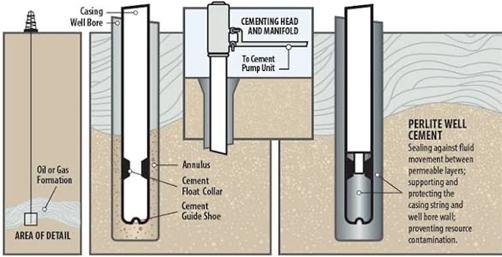
Expanded perlite is a lightweight, volcanic glass aggregate used in oil and gas drilling primarily as a cement additive to create low-density, high-strength slurries and as a fluid loss agent. It improves zonal isolation, reduces slurry density, and bridges fractures, enhancing cementing efficiency and controlling lost circulation in challenging, high-pressure, or high-temperature environments.
Key Usage and Applications in Oil & Gas :
❖ Lightweight Well Cementing: Perlite is used as a lightweight aggregate in cementing operations, reducing the density of slurry to prevent the fracturing of weak or porous formations. It can be blended with cement to achieve lower density, providing superior compressive strength and better zonal isolation.
❖ Lost Circulation Material (LCM): Its porous, lightweight, and cellular structure makes it an effective LCM, helping to bridge voids, fissures, and porous zones in the borehole, which prevents the loss of drilling fluids into the formation.
❖ Thermal Insulation in Wells: Due to its excellent insulating properties, expanded perlite is used in cementing to minimize thermal stress on wellbore components in high-temperature, high-pressure (HTHP) environments, particularly in geothermal or deep-sea drilling.
❖ Improved Cement Slurry Performance: Perlite reduces the amount of water required in cement slurries compared to other additives, resulting in a stronger, more durable, and more impermeable seal between the casing and the formation.
❖ Drilling Fluid Additive: In some applications, it is used to enhance the filtration control of water-based muds, improving the stability and sealing properties of the filter cake.
Key Benefits:
Density Reduction: Significantly lowers the weight of cement slurries.
High Strength: Enhances the compressive strength of cement, ensuring long-term structural integrity.
Cost-Effective: Its low density and high volume reduce material costs.
Chemical Stability: It is inert and non-toxic, making it suitable for complex subsurface environments.
Dosage:
Base cement sample (without perlite) and perlite cement sample (with 4% by weight of cement of perlite) were prepared under high pressure and high temperature to examine their effect on the oil-well cement properties such as compressive strength, viscosity, permeability, and particles settling.
Expanded Perlite
Integrating perlite into the cement composition increased its strength, leading to an 88% improvement in compressive strength compared to the base cement. The inclusion of perlite particles resulted in a 30% reduction in the viscosity. Furthermore, the addition of perlite decreased the cement permeability by 66%. Additionally, perlite effectively minimized the particles settling along the cement column to a minimal percentage of 0.1%.